A food truck plan built on your town’s real numbers
See your startup cost, break-even and local competition free — from Census and Bureau of Labor Statistics data for your county. Then get the complete, lender-ready plan for $49.
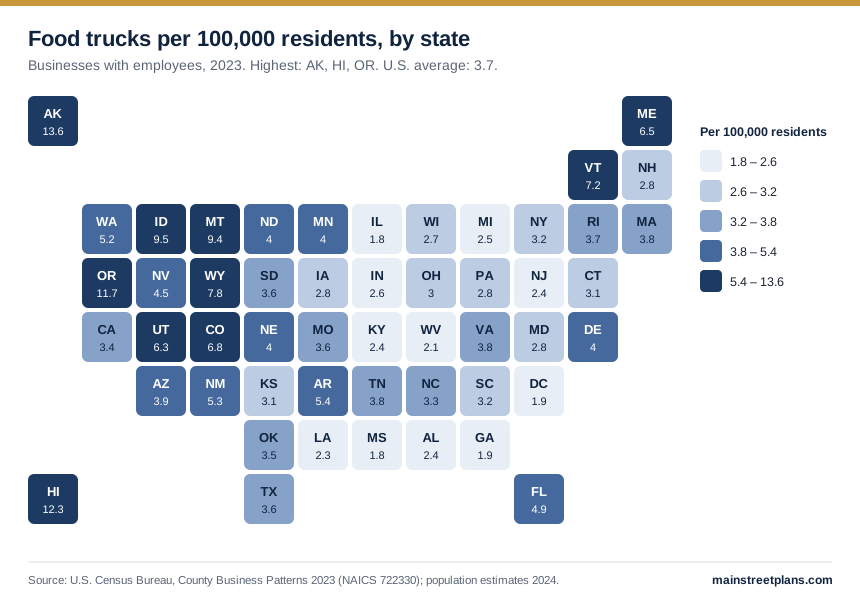
The food truck industry in numbers
Industry code 722330 (Mobile Food Services). Your plan uses the figures for your own county or metro area.
| Employer businesses in the U.S. (2023) | 12,487 |
| Average yearly sales, employer business (2022) | $297,317 |
| Average employees per employer business | 2.9 |
| Mean hourly wage, Cooks, Restaurant (2025) | $18.62 |
Sources: U.S. Census Bureau (County Business Patterns, Economic Census, Nonemployer Statistics); U.S. Bureau of Labor Statistics (OEWS).
What’s in your food truck plan
- An executive summary a lender can read in two minutes
- A market analysis for your county: competitors, density, growth and average sales
- Startup budget, monthly costs and break-even in orders per day
- A three-year projection with operating profit and cash after loan payments
- Marketing, operations and staffing plans written around your concept
- A licenses and permits checklist, a risk register and a step-by-step launch plan
What your food truck plan looks like
See the whole sample →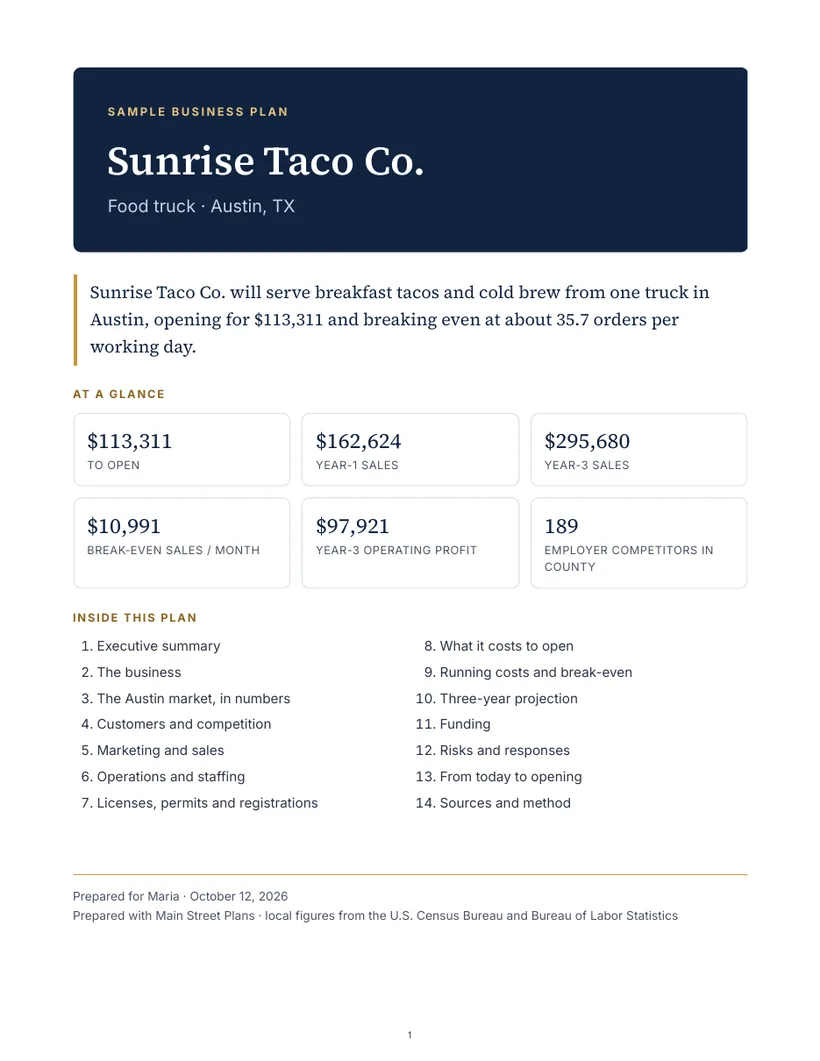
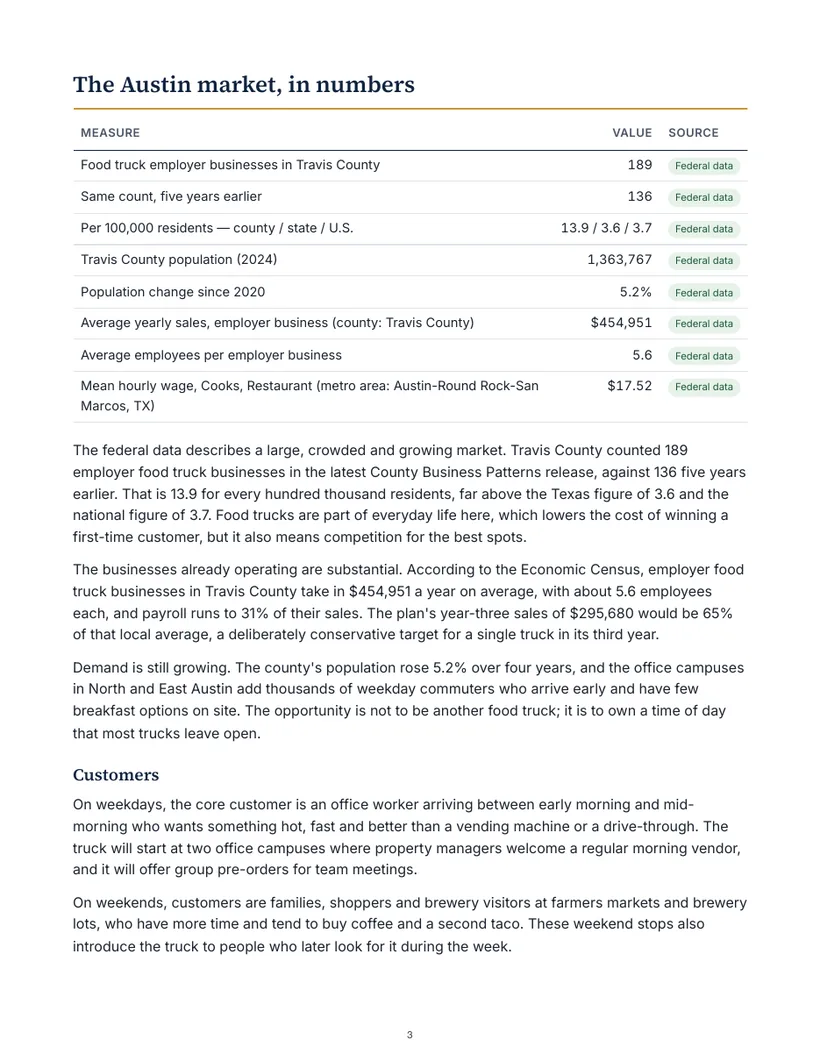
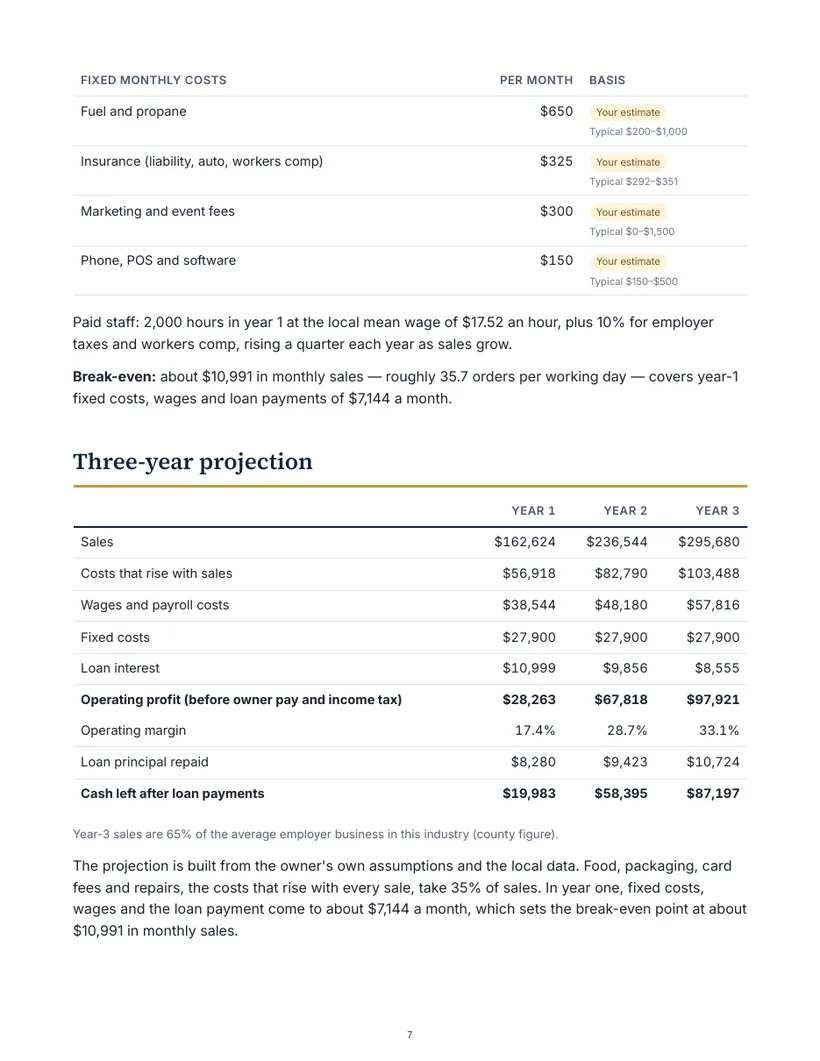
Pages from our sample plan for a food truck in Austin, Texas. Yours is written for your business and built on your county’s data.
Start yours — your numbers are free to see first.
Licenses and permits to line up
Requirements differ by state, county and city — confirm each with your local offices.
- Mobile food vendor permit or license (health department — county, city or state, depending on where you operate)
- Fire safety inspection for cooking equipment and propane
- Commissary agreement (most health departments require a licensed home base)
- Food manager certification and food handler cards for staff
- Sales tax permit from your state revenue department
- Business registration with your Secretary of State, plus a federal EIN
- Commercial auto and general liability insurance
- Location permissions: private-property agreements or city street-vending rules
Where food trucks concentrate
Counties with the most employer businesses in this industry (County Business Patterns, 2023).
| Los Angeles County, CA | 289 |
| Maricopa County, AZ | 196 |
| Travis County, TX | 189 |
| Miami-Dade County, FL | 155 |
| Multnomah County, OR | 154 |
| San Diego County, CA | 151 |
| King County, WA | 133 |
| Harris County, TX | 126 |
| Queens County, NY | 112 |
| Clark County, NV | 110 |
Food truck guides
Questions
How much does it cost to start a food truck?
Typically $70,000–$218,000, including a cash reserve for the first months — based on published prices and cost data for each line. The biggest swing is truck, kitchen build-out and fire suppression. Enter your own quotes and your city in the calculator above for your number.
How much does a food truck make?
Nationally, food trucks with employees averaged $297,317 in yearly sales in the 2022 Economic Census. Your plan shows the figures for your own county or metro area where the Census publishes them.
Can I use this plan to apply for a loan?
Yes. It follows the structure lenders and the SBA’s own guidance expect: executive summary, business description, market analysis, marketing and operations, management, funding request and financial projections. We can’t promise approval — your lender decides — and we are not affiliated with the SBA.
Where do the numbers come from?
Local competitor counts come from the Census Bureau’s County Business Patterns, average sales from the Economic Census and Nonemployer Statistics, wages from the Bureau of Labor Statistics, and population from Census estimates. Prices, volumes and equipment costs are your own estimates — the plan labels every number by source.
Is the plan written by AI?
The numbers are calculated, not generated: every figure is computed from federal data and your answers. The text is drafted by an AI writer that works only from those calculated figures and your description, and the plan is checked so it can’t contain a number we didn’t compute.
What if I’m not happy with it?
If your plan has a factual or calculation error, we fix it. If we can’t deliver your plan, you get a full refund. See the refund policy for details.
Main Street Plans is not affiliated with the SBA or any government agency.